GR®
Long Distance Hiking Trails
Stopover gîtes, Bed & Breakfasts, Guest houses, Hotels, Campsites, Shelters, Inns
Webmaster: Philippe Papadimitriou L'Etoile Guesthouse Creation: 2001 Copyright©gr-infos.com (Authorization for private use only)
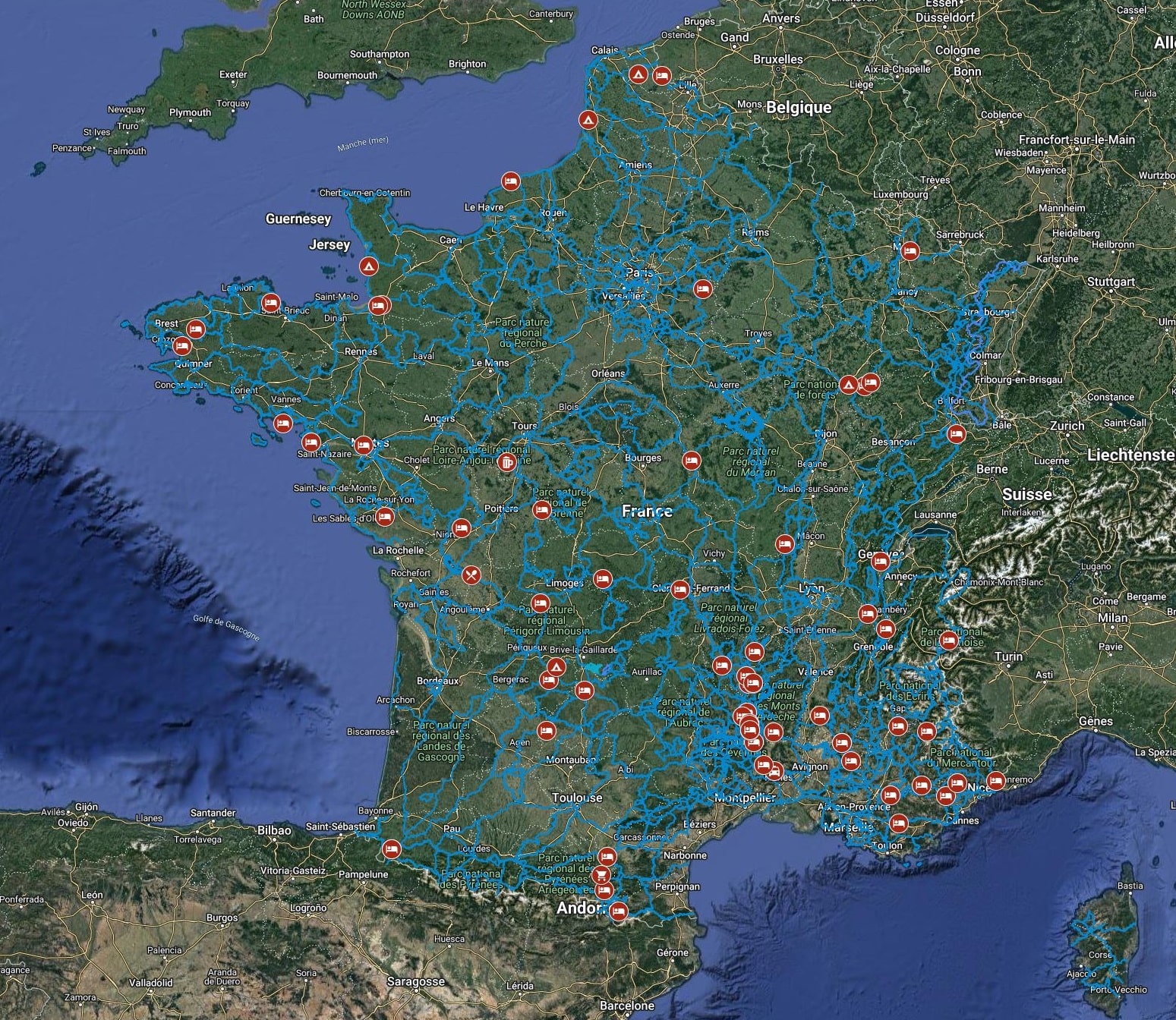
Loading time for the interactive map
The GR® (Grandes Randonnées or Long Distance Hiking Trails) form a network of hiking trails in France that offer outdoor enthusiasts the opportunity to explore the country on foot through diverse and beautiful landscapes. These marked trails are maintained by the Fédération Française de la Randonnée Pédestre (FFRP) and provide a unique experience of discovering French nature, history, and culture. The GR® network covers the entire French territory, from coastal areas to alpine mountains, passing through green countrysides and picturesque villages. Each trail is numbered and signposted, providing hikers with easy and safe navigation throughout their journey.
The GR® trails offer a wide variety of landscapes. Hikers can explore the wild coasts of Brittany and Normandy on the GR®34, following the Atlantic coastline. They can also embark on a mountain adventure on the GR®10, which traverses the Pyrenees, offering spectacular panoramas of snow-capped peaks, deep valleys, and crystal-clear lakes. The GR® trails also cross iconic regions such as Provence, Corsica, Burgundy, Alsace, and many more. These trails provide insights into the history and culture of France. Hikers can discover prehistoric ruins, medieval castles, centuries-old abbeys, and traditional villages along their journey. The GR® trails also pass through regional nature parks, nature reserves, and UNESCO World Heritage sites, providing an immersive experience in France's preserved nature and biodiversity.
The GR® trails are designed to cater to the needs and abilities of all hikers. Whether you're a beginner hiker looking for leisurely day walks or an experienced trekker ready to tackle more challenging multi-day hikes, there is a GR® trail suited for every fitness level and experience. In addition to their sporting and recreational aspects, the GR® trails allow hikers to reconnect with nature, recharge, and enjoy moments of peace and tranquility. The trails also provide opportunities to meet other hiking enthusiasts, share experiences, and create lasting memories. In summary, the GR® trails constitute an exceptional network of signposted paths that allow hikers to discover the beauty, diversity, and history of France through varied and magnificent landscapes.
GR®1 Tour of Ile de France GR®2 The Seine River Trail GR®3 The Loire River Trail GR®4 From the Atlantic to the Mediterranean GR®5 From Luxembourg to the Mediterranean GR®5E From Bonneval-sur-Arc to Modane (Savoie) GR®5G From Saarbrucken (Germany) to Metz (Moselle) GR®6 From Gironde to Alpes-de-Haute-Provence GR®7 From the Vosges to the Pyrenees GR®8 From the Loire to the Sèvre GR®9 From the Jura to the Mediterranean GR®10 The Great Traverse of the Pyrenees GR®11 Tour of the Pays d'Ile de France GR®12 From Gue-d'Hossus (Ardennes) to Commelles ponds (Oise) GR®13 From Gatinais (Seine-et-Marne) to Morvan (Saone-et-Loire) GR®14 Ardennes Trail GR®20 Crossing Corsica GR®21 Cliffs Trail GR®22 Mont Saint-Michel Trail GR®23 From Sotteville-sous-le-Val (Seine-Maritime) to Honfleur (Calvados) GR®25 From Sotteville-sous-le-Val to Montville (Seine-Maritime) GR®26 From Poissy (Yvelines) to Villers-sur-Mer (Calvados) GR®30 Around Auvergne volcanoes and lakes (Puy-de-Dome) GR®31 Crossing Sologne (Nievre, Cher, Loir-et-Cher) GR®32 From St-Fargeau-Ponthierry (Seine-et-Marne) to Checy (Loiret) GR®34 Customs Officers' Path GR®34E From Pont de Saint-Maurice (Finistere) to Pont Neuf (Morbihan) GR®35 From La Loupe (Eure-et-Loir) to Rochefort-sur-Loire (Maine-et-Loire) GR®36 From the Channel to the Pyrenees GR®37 Heart of Brittany GR®38 From Douarnenez (Finistere) to Redon (Ille-et-Vilaine) GR®39 From Mont Saint Michel (Manche) to Hoscas (Loire-Atlantique) GR®40 Around Velay region (Haute-Loire) GR®41 Cher Valley Trail GR®42 From St Etienne (Loire) to Le Grau-du-Roi (Gard) GR®43 From Faisses Pass to Sainte Eulalie (Lozere) GR®44 From Les Vans (Ardeche) to Champerboux (Lozere) GR44®B From Les Vans (Ardeche) to Vieille Morte Mount (Lozere) GR®46 From Tours (Indre-et-Loire) to Toulouse (Haute-Garonne) GR®48 From Chinon (Indre-et-Loire) to La Ribiere (Haute-Vienne) GR®49 From Saint Raphael (Var) to Rougon (Alpes de Haute-Provence) GR®50 Tour of the Ecrins National Park (Hautes-Alpes, Isere) GR®51 Balcony of the Mediterranean GR®52 From Entraunes to Menton (Alpes-Maritimes) GR®53 From Wissembourg (Bas-Rhin) to Engin Pass (Moselle) GR®54 Tour of the Oisans and Ecrins Massifs (Isere, Hautes-Alpes) GR®55 Vanoise National Park: From Tignes to Modane (Savoie) GR®56 Tour of the Ubaye (Alpes-de-Haute-Provence, Alpes-Maritimes) GR®57 Thabor Mount (Hautes-Alpes) GR®58 Tour of the Queyras (Hautes-Alpes) GR®59 From the Vosges to the Jura GR®60 From Signal de Mailhebiau (Lozere-Aveyron) to St Mathieu-de-Treviers (Herault) GR®61 From Anduze to Asclier Pass (Gard-Cevennes) GR®62 From Conques (Aveyron) to Roque-Rouge (Gard) GR®62A From Combescure Ravine (Aveyron) to Meyrueis (Lozere) GR®63 From Avignon (Vaucluse) to Cabane-Vieille Pass (Gard) GR®64 From Ouysse River bridge (Lot) to Eyzies-de-Tayac-Sireuil (Dordogne) GR®65 Way of Saint James GR®66 Tour of Aigoual Mount (Cevennes National Park) GR®67 Tour of the Cevenol Region (Gard, Lozere) GR®68 Tour of Mount Lozere (Gard, Lozere) GR®69 La Routo GR®70 Stevenson Trail GR®71 From L'Esperou (Gard) to Lodeve (Herault) GR®71C Tour of the Templars and Hospitallers (Aveyron) GR®71D Tour of the Larzac (Aveyron) GR®72 From Bez Pass (Ardeche) to Barre-des-Cevennes (Lozere) GR®74 From St Maurice-Navacelles to Jouquet (Herault) GR®75 Tour of Paris GR®76 From Chagny (Saone-et-Loire) to Affoux (Rhone) GR®76A From St-Vallerin (Saone-et-Loire) to Mt Saint-Rigaud (Rhone) GR®76B From Martrat (Le Rousset) to Tournus (Saone-et-Loire) GR®77 From Saut de Vezoles (Herault) to Alaric Signal (Aude) GR®78 Piemont Way GR®81 Amadour Way GR®86 From Toulouse to Bagneres-de-Luchon (Haute-Garonne) GR®89 Montaigne Trail GR®90 From Le Lavandou to Notre Dame des Anges (Var) GR®91 Crossing the Vercors Highlands GR®93 Crossing the Vercors GR®94 From Vaunieres to Praux Pass (Hautes-Alpes) GR®95 From Saillans (Drôme) to Vaunières (Hautes Alpes) GR®96 From Samoens (Haute-Savoie) to Aix-les-Bains (Savoie) GR®98 From La Madrague to Col du Pilon (Bouches-du-Rhone) GR®99 From Revest-les-Eaux to Trigance (Var) GR®100 The Hundred Years' War Paths GR®101 From Nogaro (Gers) to Saucede Pass (Hautes-Pyrenees) GR®105 Aure Valley Path GR®107 Bonshommes Way (Ariege, Aude, Pyrenees-Orientales) GR®108 Ossau Way (Pyrenees-Atlantiques) GR®113 From Provins (Seine-et-Marne) to Auxerre (Yonne) GR®120 Coastal Path GR®121 From Bon-Secours (Belgium) to Equihen-Plage (Pas-de-Calais) GR®121B From Bailleul (France-Belgium border) to Rieulay (Nord) GR®121C From Aubigny-au-Bac to Le Quesnoy (Nord) GR®122 From Bon-Secours (Belgium) to Son (Ardennes) GR®123 From Contes (Pas-de-Calais) to Carlepont (Oise) GR®124 From Rebreuviette (Pas-de-Calais) to Cires-les-Mello (Oise) GR®125 From La Cressonniere (Val-d'Oise) to St Valery-sur-Somme (Somme) GR®128 Flanders Way GR®130 Yser River Trail GR®131 From Mont-Beuvray (Morvan) to Issy-l'Eveque (Saone-et-Loire) GR®132 From La Sausseliere (Loiret) to Chaumot (Yonne) GR®137 From Autun (Saone-et-Loire) to Nolay (Cote-d'Or) GR®142 From Verzenay (Marne) to Laon (Aisne) GR®145 Via Francigena GR®169 Tour of Lyon (Rhone) GR®210 In the Footsteps of the Chasse-Marée GR®211 From Veulettes-sur-Mer to Caudebec-en-Caux (Seine-Maritime) GR®212 From Ste Marguerite-sur-Mer to Le Paulu (Seine-Maritime) GR®213 From Chamesson (Cote-d'Or) to Vezelay (Yonne) GR®221 From Pont de la Roque (Manche) to Verneuil d'Avre et d'Iton (Eure) GR®222 From Pîtres to Verneuil d'Avre et d'Iton (Eure) GR®223 Normandy Coast GR®223A Cherbourg Balconies GR®224 From Berville-sur-Mer to Verneuil d'Avre et d'Iton (Eure) GR®226 From Vaux (Calvados) to Gue-Rochoux (Manche) GR®235 From La Touzeliere to La Vallee de la Flotte (Sarthe) GR®300 St Michael's Way GR®302 Source and Gorges of the Loire GR®303 Land of the Bourbons GR®340 Tour of Belle-Ile-en-Mer (Morbihan) GR®342 From Montluçon (Allier) to Roanne (Loire) GR®360 Tour of Saintonge GR®364 From Poitou to the Ocean GR®365 From La Chapelle-Janson (Ille-et-Vilaine) to Durtal (Maine-et-Loire) GR®367 Cathar Trail GR®380 Tour of the Arree Mounts (Finistere, Cotes-d'Armor) GR®400 Tour of the Cantal Volcanoes (Auvergne) GR®406 Napoleon Way GR®413 From La Chaussée-le-Comte to Villefranche-sur-Cher (Loir-et-Cher) GR®420 Tour of the Haut-Vivarais (Ardeche) GR®422 In the Footsteps of Charles IX GR®429 From Dieulefit (Drome) to Viviers (Ardeche) GR®430 Way of Saint Regis (Haute-Loire, Ardeche) GR®440 Tour of the Limousine Mountain (Correze, Haute-Vienne, Creuse) GR®441 Tour of the Chaîne des Puys (Puy-de-Dôme) GR®465 From Murat (Cantal) to Conques (Aveyron) GR®470 Allier River Springs and Gorges (Haute-Loire, Lozere) GR®480 From Turenne to the Gorges of Cere (Correze) GR®501 Moselle River Path GR®509 Great Crossing of the Jura GR®510 The 8 Valleys Trail (Alpes-Maritimes) GR®531 Across the Vosges Massif GR®532 Vosges Crests and High Valleys GR®533 Vosges Crests and Lakes GR®534 Stanislas-Kleber Trail GR®559 From Lons-le-Saunier to Les Rousses (Jura) GR®559A From Bayard (Foncine-le-Haut) to La Clouterie (Bonlieu) (Jura) GR®620 Horizons and Bell Towers of Rouergue GR®636 From Bernasse (Dordogne) to Lacapelle-Biron (Lot-et-Garonne) GR®646 From Perigueux (Dordogne) to Ste-Foy-la-Grande (Gironde) GR®651 Cele Valley (Lot) GR®652 Rocamadour Way GR®653 Way of Arles - Via Tolosana GR®653A Via Aurelia GR®653D Via Domitia GR®654 Vézelay Way GR®654 EAST From Bergerac (Dordogne) to Montreal-du-Gers (Gers) GR®655 Via Turonensis GR®655 EAST From Villebon-sur-Yvette (Essonne) to Vouvray (Indre-et-Loire) GR®670 From Saint Flour (Cantal) to St Germain-de-Calberte (Lozère) GR®700 Regordane Way GR®703 Historical Trail of Joan of Arc GR®714 From Bar-le-Duc (Meuse) to Dombrot-le-Sec (Vosges) GR®736 Tarn Valley and Gorges GR®738 High Crossing of Belledonne GR®765 From Cluny (Saone-et-Loire) to Puy-en-Velay (Haute-Loire) GR®765 EAST From Lyon (Rhone) to Puy-en-Velay (Haute-Loire) GR®765 WEST From Montarcher (Loire) to Polignac (Haute-Loire) GR®782 Henri IV Way GR®787 From St-Gervais-sur-Mare to Capestang (Herault) GR®800 Somme River Trail GR®861 Via Garona GR®965 In the Footsteps of the Huguenots GR®2013 Marseille-Provence (Bouches-du-Rhone) Reunion Island GR®R1 Tour of the Piton des Neiges GR®R2 From St Denis to Le Baril (St Philippe) GR®R3 Tour of the Mafate Cirque Corsica From Calenzana to Corscia (Haute-Corse) (North) From Calenzana (Haute-Corse) to Cargese (Corse-du-Sud) (South) From Porticcio to Propriano (Corse-du-Sud) (North) From San-Nicolao (Haute-Corse) to Cargese (Corse-du-Sud) (Center) From Serra-di-Fiumorbo (Haute-Corse) to Grosseto-Prugna (Corse-du-Sud) (South) From Porto-Vecchio to Propriano (Corse-du-Sud)
Other hikes
Tour of France on foot Tour of the Monts d'Ambazac (Haute-Vienne) Tour of the Arcachon Bay (Gironde) Tour of the Montagne Ardéchoise (Ardèche) Tour of the Argonne Region (Marne, Ardennes, Meuse) Tour of the Artois Region (Pas-de-Calais) Tour of the Artois Highlands (Pas-de-Calais) Tour of the Monts d'Aubrac (Lozère-Aveyron-Cantal) Tour of the Avallonnais (Yonne, Nièvre) Tour of the Mont des Avaloirs (Mayenne, Orne, Sarthe) Tour of the Gaston Bachelard Country (Aube) Tour of the Valromey Balcony (Ain) Tour of the Provençal Baronnies (Drôme) Tour of the Baronnies de Bigorre (Hautes-Pyrénées) Tour of the Bigouden Region (Finistère) Tour of the Monts de Blond (Haute-Vienne) Tour of Bordeaux (Gironde) Tour of the Boulonnais (Pas-de-Calais) Tour of the Brenne (Vienne, Indre, Indre-et-Loire) Tour of the Bresse Comtoise (Jura) Tour of the Buëch (Hautes-Alpes, Drôme) Tour of the Buëch and Méouge (Drôme, Hautes-Alpes) Tour of the Canche and Authie Valleys (Pas-de-Calais) Tour of the Capcir (Pyrénées-Orientales) Tour of the Carlit (Eastern-Pyrenees) Tour of the Waterfalls, Heathlands, and Peat Bogs (Creuse) Tour of the Pays de Caux and Seine Valley (Seine-Maritime) Tour of the Ile-de-France Green Belt Tour of the Cerdagne (Eastern-Pyrenees, Catalogna-Spain) Tour of the Ain Valley in the Cerdon Region (Ain) The Cevenol (Lozere, Ardeche, Gard) Tour of the Upper Cèze Valley (Gard-Ardèche) Tour of Upper Chalosse (Landes) Tour of the Chartreuse Massif (Isere, Savoie) Tour of the Chassezac (Lozere) The Cider Tour of the Pays d'Othe (Aube, Yonne) Tour of the Cotentin Peninsula (Manche) Tour of Courbet Country (Doubs) Tour of Coutances to the Sea (Manche) Tour of the Crozon Peninsula (Finistère) Tour of Northern Deodatie (Vosges, Meurthe-et-Moselle) Tour of Southern Déodatie (Vosges) Tour of the Two Bars (Aube) Tour of the Dieulefit Region (Drôme) Crossing of the Dombes (Rhône-Ain) Between Dordogne and Ventadour (Correze) Tour of the Duchy of Normandy Borders (Eure) Tour of the Ecueillé Region (Indre) Between Two Lakes. From Avene to Salagou (Herault) Tour of the Gabariers (Correze) Tour of the Vallee du Galeizon (Gard-Lozere) Tour of the Heart of Gascony (Gers) Tour of the Gervanne (Drôme) Tour of the Loire Gorges (Haute-Loire) The Great Wines Trail (Cote-d'Or) Tour of the Isle of Groix (Morbihan) Tour of the Hautes Terres d'Oc (Tarn, Hérault) Tour of the Upper Thoré Valley (Tarn, Aude, Hérault) Tour of the Meuse Heights Tour of Houat Island (Morbihan) Tour of Yeu Island (Vendée) Tour of Joan of Arc Country (Meuse, Vosges) Jura Escape Tour of Labourd in the Basque Country (Pyrénées-Atlantiques) Tour of Grand-Lieu Lake (Loire-Atlantique) Tour of Amance and Temple Lakes (Aube) Tour of Southern Larzac (Hérault-Gard) Tour of the Lévézou Lakes (Aveyron) Tour of the Lévézou Mountains (Aveyron) Tour of the Vienne Limousine (Vienne) Tour of Lo Camin d'Olt (Aveyron, Cantal) Tour of the Lomont Mountains (Doubs) Tour of the Otter Trail (Vendée) Tour of the Luberon (Vaucluse, Alpes-de-Haute-Provence) Tour of the Upper Luech Valley (Gard, Lozère) Tour of Lure Mountain (Alpes-de-Haute-Provence) Tour des Coteaux du Lyonnais (Rhône) Tour of the Monts du Lyonnais (Rhône-Loire) Tour of the Monk’s Robe and Chainmail (Haute-Loire) Tour of the Pays Malouin (Ille-et-Vilaine) Tour of the Mandragore (Charente, Haute-Vienne) Tour of the Maquisards (Aube) The Marches of Brittany (Mayenne, Ille-et-Vilaine) Tour of the Marches de Gatine (Deux-Sevres, Vienne) Tour of the Marches of the Meuse Tour of the Margeride (Lozere) The Queen Margot Heritage Trail (Puy-de-Dôme) Tour of the Marne and the Two Morin Rivers (Seine-et-Marne) Tour of the Yonne Meanders Tour of the Causse Méjean (Lozère) Tour of Mélusine Country (Vendée) Tour of the Southern Corrèze Tour of Southern Quercy (Tarn-et-Garonne, Tarn, Lot) Tour of the Millevaches Plateau (Corrèze) Tour of the Dentelles de Montmirail (Vaucluse) Tour of the Mortainais Ridges (Manche, Orne) Tour of the Morvan (Nievre, Saone-et-Loire, Cote-d'Or, Yonne) Tour of the Nantes Region (Loire-Atlantique) Tour of the Omois (Aisne, Marne, Oise) Tour of the Othe Forests (Aube) Tour of the Isle of Ouessant (Finistère) Crossing Paris (West-East) Crossing Paris (North-South) Crossing Paris (West-East-South) Crossing Paris (East-West-North) Tour of the Perics (Eastern-Pyrenees, Ariege) Tour of the Petites Roches (Isère) Tour in the Grand Pic St-Loup. From Londres to the Buèges (Hérault) Tour in the Grand Pic St-Loup. From the Séranne to the Hérault gorges Tour in the Grand Pic St-Loup. From the Vines to the Causses (Hérault) Tour in the Grand Pic St-Loup. The Peak's Villages (Hérault) Tour of Porquerolles Island (Var) Tour of the ridges of Port Cros Island (Var) Tour of the Fiefs of Pouzauges (Vendée) Tour of the Puys of Pouzauges (Vendée) Great Crossing of the Prealps (Hautes-Alpes, Alpes-de-Haute-Provence) Tour of the Provence Mines d'énergies East (Bouches-du-Rhône) Tour of the Provence Mines d'énergies North (Bouches-du-Rhône) Tour of the Provence Mines d'énergies South (Bouches-du-Rhône) Tour of the Rance River (Côtes-d'Armor, Ille-et-Vilaine) Tour of the Rasteau Massif (Vaucluse) Tour of Rétif de La Bretonne Country (Yonne) Tour of the Revermont (Ain, Jura) Tour of the Roanne Valley (Drôme) Tour of Lake Salagou (Hérault) Tour of the Sarce and Hozain Valleys (Aube) Tour of the Causse Sauveterre (Lozère, Aveyron) Tour of the Balconies of the Sée River (Manche) Tour of the Sèvre and Maine Bocage (Loire-Atlantique, Vendée) Tour of the Sèvre and Maine Hills (Vendée) Tour of the Sèvre et Maine Vineyards (Vendée, Loire-Atlantique) Tour of Sologne (Loiret, Cher, Loir-et-Cher) In the Footsteps of the Master Bagpipers (Indre, Cher, Allier) Tour of Suisse Normande (Calvados, Orne) Crossing the Sylve d'Argenson (Deux-Sevres, Charente-Maritime) Tour of the Tanargue (Ardèche) Tour of the Ternois Region (Pas-de-Calais) Tour of Mont-Blanc (Haute-Savoie, Suisse et Italie) Tour of the Three Villages in the Pays Toy (Hautes-Pyrénées) Tour of the Truyère Gorges (Cantal, Lozère) Tour of the Uchaux Massif (Vaucluse) Tour of the Valençay Region (Indre, Loir-et-Cher) Tour of the Vaucluse Mounts Tour of the Ventoux Mount (Drome, Vaucluse) Tour of the Vézère Gorges (Corrèze) Tour between the Vie and Yon Rivers (Vendée) Tour of the Viganais Region (Gard) Wine and Cheese Trail (Yonne, Aube) Tour of the Vologne (Vosges) Tour of the Woëvre Plain (Meuse) Tour of the Xaintrie Blanche (Corrèze) Tour of the Xaintrie Noire (Correze) Crossing the Yvelines Saint-Guilhem-le-Désert Way (Lozere, Aveyron, Gard, Herault) Way of St James of Compostela Urbain V Way HexaTrek From the Vosges to the Pyrenees
We recommend following the trail markers throughout your hike and carrying the FFRandonnée topo-guide . You will also find useful information on MonGR.fr .
® The acronyms GR® GRP® PR, as well as the corresponding trail markers (white/red, yellow, and yellow/red), are registered trademarks of the French Hiking Federation (FFRP) . They may not be reproduced without permission. The FFRP, recognized as a public utility, brings together the associations that create and maintain the hiking trails on the GR® GRP® PR networks. It publishes topo-guides for these hiking routes. With your donations , support the actions of the thousands of volunteer trail markers of the FFRP.
GR-Infos.com is an editorial partner of MonGR.fr.
A former holiday hotel with a garden along the Allier river, L'Etoile Guest House is located in La Bastide-Puylaurent between the Lozère , the Ardèche, and the Cévennes in the mountains of Southern France. At the crossroads of the GR®7 , GR®70 Stevenson Trail , GR®72 , GR®700 Regordane Way , GR®470 Allier River Springs and Gorges, and the GRP® Cévenol , Ardéchoise Mountain , and Margeride trails. It offers numerous loop routes for day hikes and cycling excursions. Ideal for a relaxing and hiking getaway.
Copyright©gr-infos.com (Authorization for private use only)